Mexico's 2026 Sargassum Strategy for Quintana Roo: Federal Investment, Containment Measures and Implementation in Cancún and the Riviera Maya
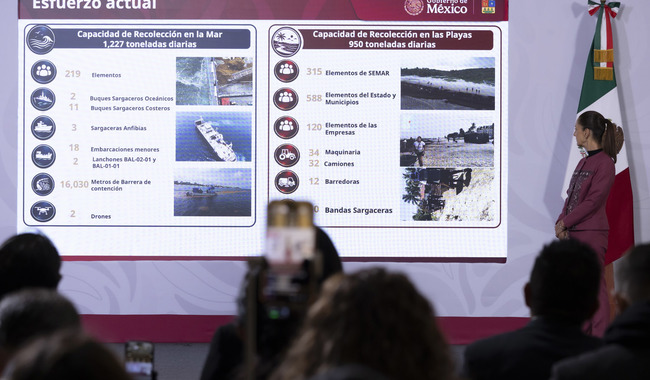
President Claudia Sheinbaum at the morning press conference at the National Palace on 30 July 2026, beside a slide presenting the current collection capacity: 1,227 tonnes a day at sea and 950 tonnes a day on beaches. Photo: Presidencia de la República.
On 30 July 2026, President Claudia Sheinbaum presented a federal strategy for the containment and management of sargassum in Quintana Roo, with an announced investment of 2,635.6 million pesos. The strategy is to be carried out by the Mexican Navy (SEMAR), the Quintana Roo state government, the Ministry of Environment and Natural Resources (Semarnat), the national tourism development fund (Fonatur) and the hotel sector, and concentrates its new equipment on five stretches of coast: Cancún, Playa del Carmen, Puerto Morelos, Tulum and Mahahual.12 This article summarises the measures announced, the equipment already in operation and the progress reported by September 2026.
This article summarises official announcements and their published coverage. All figures belong to the agencies and publications cited below.
The scale of the 2026 season
The plan responds to the heaviest season on record. At the presentation, the Secretary of Environment, Alicia Bárcena, stated that the volume of sargassum in 2026 was four times that of 2025 and 27 times the historical average.3 The quantity floating off the Mexican Caribbean ranged between 40,000 and 90,538 tonnes a day.4 The Navy reported 96,151 tonnes collected by the end of July, already above the 92,782 tonnes collected in the whole of 2025.35
Most of that material was removed from the sand rather than at sea. The Secretary of the Navy, Admiral Raymundo Pedro Morales Ángeles, reported that 80,314 tonnes had been collected on beaches and 5,838 tonnes at sea in 2026, and stated that the intention of the plan is to reverse that proportion.3
Structure of the strategy
The Navy described the strategy as resting on four lines of work: collection in open water, collection in shallow coastal water, collection on beaches, and final disposal of the collected seaweed, either for industrial use or for confinement.3 The investment is divided into two stages.
First stage
The first stage carries 768.7 million pesos and aims to raise collection capacity at sea from 1,227 to 1,870 tonnes a day. It provides for two tugboats, six coastal collection boats, 1.5 kilometres of dynamic barriers and about 50 kilometres of coastal containment barriers in the five priority destinations.135
Second stage
The second stage, with larger investment, aims to reach 4,000 tonnes a day, which the Navy described as the average volume of arrival, through additional collection ships, containment barriers and beach equipment.32 Reporting on the announcement placed this stage in 2027.5
In September 2026 the Navy itemised the full programme as two ocean-going collection ships, six semi-ocean-going vessels, six tugboats, 1,500 metres of dynamic barriers, 35 kilometres of containment and redirection barriers, a monitoring and early-warning system, and a new dock at Puerto Juárez in Cancún.6 The figure of 35 kilometres differs from the 50 kilometres of coastal barrier cited at the July presentation, and the difference has not been publicly explained.
Final disposal and reuse
Collected sargassum is to be sent to four sites where it will be dried and pre-treated for the production of biofertiliser, biochar and biogas.5 The President stated that around 150 scientists are working with Semarnat and the Ministry of Science to establish why 2026 produced so much sargassum and which uses of the collected biomass can be made profitable.5
The state government's contribution
The Quintana Roo government, led by Governor Mara Lezama, has contributed more than 770 million pesos of state funds to sargassum management.5 The state also operates the barrier programme with the Navy: in late July, 9,450 metres of barrier were operating in Puerto Morelos, Playa del Carmen, Tulum and Mahahual, against a target of 16,030 metres for the year, and the head of the state environment secretariat acknowledged that strong waves had damaged part of the barriers in Cancún and Playa del Carmen.7
Tourism decline and recovery measures in Tulum
The plan responds to a sustained fall in tourism. According to figures from the state tourism secretariat (Sedetur), hotel occupancy in Tulum fell from 63 per cent in the first week of August 2025 to 48 per cent in October, the sharpest decline among the destinations of the Mexican Caribbean over that period.8 Tulum International Airport handled about 1.2 million passengers in 2025; in the first quarter of 2026 it received around 178,000 international passengers, 34 per cent fewer than in the same period a year earlier.910 An aviation analyst quoted by El Universal projected about 700,000 passengers for 2026, after seat capacity for May fell by 60 per cent year on year.10 Hotel occupancy in Tulum averaged 48.8 per cent in the last week of June 2026,11 and in September the president of the Tulum Hotel Association reported occupancy below 20 per cent in coastal hotels and below 30 per cent in all-inclusive resorts.12 Business groups cited by the Associated Press estimated that sales in Quintana Roo fell by 30 per cent in the first half of 2026.5 Analysts have attributed the decline to a combination of sargassum, insecurity, high prices, costly ground transport from the airport and reduced air connectivity.10
Two weeks before the sargassum strategy, on 17 July 2026, the federal government presented the Plan Tulum Renace, a ten-point programme to restore tourism in Tulum.13 Its central measures are free entry for Mexican visitors to the Parque del Jaguar, free public access to the beaches within it, and reduced fees for the archaeological zone and the protected natural area: 80 pesos for Mexican visitors and 265 pesos for foreign visitors covering the full visit.1314 The plan also provides for a new entrance to the park, an ecological car park at the southern access, and a programme to attract new air routes to Tulum.13
Implementation as of September 2026
The strategy has been announced and funded, and part of it is in operation, but the new equipment had not been reported in service by September. In a statement published on 8 September, the Navy listed the fleet then deployed as 11 coastal collection boats of 20 tonnes each, one ocean-going ship, two amphibious collectors and 18 smaller boats, with 13,230 metres of containment barrier in the water.6 A second ocean-going ship, the Sargassum, was still being fitted out; the Navy states that its entry into service will raise collection capacity at sea from 627 to 1,227 tonnes a day.6 The Navy also plans to add dynamic barriers that redirect the seaweed towards points where boats can collect it.6
By the same date, the federal government reported more than 123,400 tonnes collected in Quintana Roo in 2026, the largest volume recorded in the state.6 The tugboats, the six new coastal collection boats and the 50 kilometres of coastal barrier announced in July had not been reported as delivered in the sources reviewed for this article.
International cooperation
Cancún will host the fourth EU-Caribbean Global Gateway Conference on Sargassum on 1 and 2 October 2026. The meeting is financed by the European Union and is expected to bring together Caribbean countries with delegations from Brazil and Japan, with the aim of coordinating containment and developing uses for the collected biomass.154 Japan has indicated its willingness to provide decommissioned whaling vessels adapted for sargassum collection.5
Implications for visitors
Most of the new capacity announced in July is intended to come into service over the coming months and, in its second stage, in 2027, so its effect on beach conditions is likely to be felt mainly in future seasons rather than in the remainder of 2026. In the meantime, conditions continue to vary from one beach to the next and from one day to the next, and depend on wind, currents and the collection effort on each stretch of coast. Our guide to sargassum barriers in the Riviera Maya describes the existing containment destination by destination.
Before you book or travel: open the Forecast page for the daily satellite outlook, then use the live beach map to check current conditions at the exact beach you have in mind.
References
- Presidencia de la República, Gobierno de México (30 July 2026). Gobierno de México destina 2 mil mdp a la estrategia de atención y manejo del sargazo en Quintana Roo. Press release.
- MVS Noticias (30 July 2026). Sheinbaum destina 2,635 mdp para combatir el sargazo.
- Expansión Política (30 July 2026). Gobierno destinará 2,000 mdp para elevar a 4,000 toneladas la recolección de sargazo.
- Heraldo de México Quintana Roo (31 July 2026). Cumbre internacional contra el sargazo en Cancún: ¿cuándo es y quiénes participan?.
- Infobae (2 August 2026). El Caribe mexicano enfrenta su peor temporada de sargazo: 90.000 toneladas flotan frente a Quintana Roo.
- Excélsior (8 September 2026). Semar refuerza estrategia contra el sargazo en el Caribe mexicano.
- Por Esto (24 July 2026). Sargazo en Quintana Roo: prevén un recale superior a las 92 mil toneladas este año.
- Reportur (23 October 2025). Cancún, Tulum y Cozumel con la mayor caída en ocupación hotelera.
- Reportur (27 May 2026). Tulum: fracasa el aeropuerto al caer vuelos pese a Cuba y Jamaica.
- El Universal (25 May 2026). Aeropuerto de Tulum pierde impulso al inicio de 2026.
- 24 Horas Quintana Roo (6 July 2026). El Aeropuerto de Tulum pierde 59% de sus vuelos internacionales.
- Reportur (13 September 2026). Tulum: se hunde ocupación de hoteles costeros a menos del 20%.
- Excélsior (17 July 2026). Plan Tulum Renace: Sheinbaum anuncia entrada gratuita al Parque del Jaguar.
- La Jornada (18 July 2026). Anuncia Sheinbaum estrategia para reforzar el turismo en Tulum.
- Infobae (30 July 2026). Gobierno de México anuncia encuentro internacional en Cancún para revisar acciones contra el sargazo.