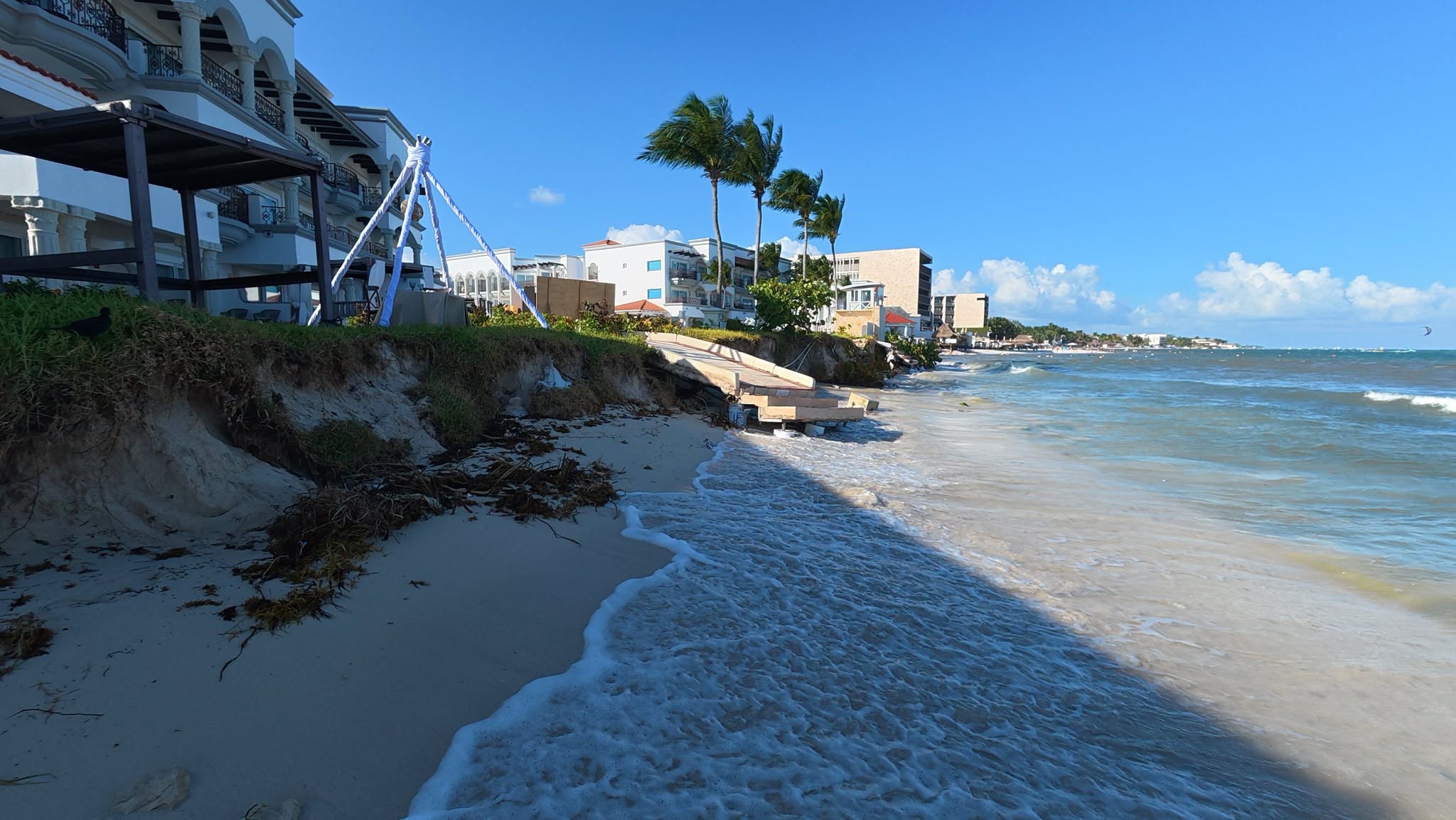
Erosion has become one of the most visible problems on the beaches of Quintana Roo. In October 2026, the state Secretary of Ecology and Environment, Óscar Rébora, stated that some parts of the state have lost up to 14 metres of beach in a single year. In central Playa del Carmen, several stretches of the town beach have been reduced to a narrow strip, and on some days to none at all.
Several responses are now under way: a state programme to restore 33.5 kilometres of beach, a municipal plan in Playa del Carmen to return sand removed with sargassum, and a series of private projects in front of individual hotels. Their progress varies: some have received federal authorisation, others remain under review, and the recent works at Playa Delfines in Cancún are unrelated to beach recovery.
The state restoration programme
The largest project is a state programme to restore eroded beaches in four municipalities. According to Secretary Rébora, Semarnat, the federal environment ministry, granted its environmental authorisation on August 12, 2026. The authorisation also covers the offshore sand banks from which sand may be taken.
- Total
- 33.5 kmof beach in four municipalities
- Cancún
- 13 kmBenito Juárez municipality
- Playa del Carmen
- 12 km
- Puerto Morelos
- 6 km
- Cozumel
- 1.5 kmapproximately
The authorisation is conditional. Before work can begin, the Quintana Roo government must submit further studies to Semarnat, the federal environment ministry, including an executive project for seven of the 33.5 kilometres, in Cancún and Puerto Morelos, which were added through the extension of an earlier authorisation. That project is to define how coastal dunes will be restored and how sand will be replenished over time. Secretary Rébora gave November 19 as the deadline for those reports. No start date for the works has been announced.
The programme is not limited to pumping sand onto the beach. When it was presented in December 2025, the state described it as including the restoration of coastal dunes with native vegetation, with some sections requiring only new sand and others requiring dune reconstruction. At that time, the cost of the Playa del Carmen section alone was estimated at 800 million pesos.
In December 2025, Secretary Rébora also attributed the worsening of erosion in part to the way hotels and homes were built on the coastal dunes, which interrupts the natural renewal of the sand.
The project has also drawn objections. In December 2025, civil society organisations and academics asked Semarnat to require a new, up-to-date environmental impact assessment rather than extend an authorisation originally issued in 2009 for earlier beach rehabilitation in Cancún, Playa del Carmen and Cozumel.
Erosion in central Playa del Carmen
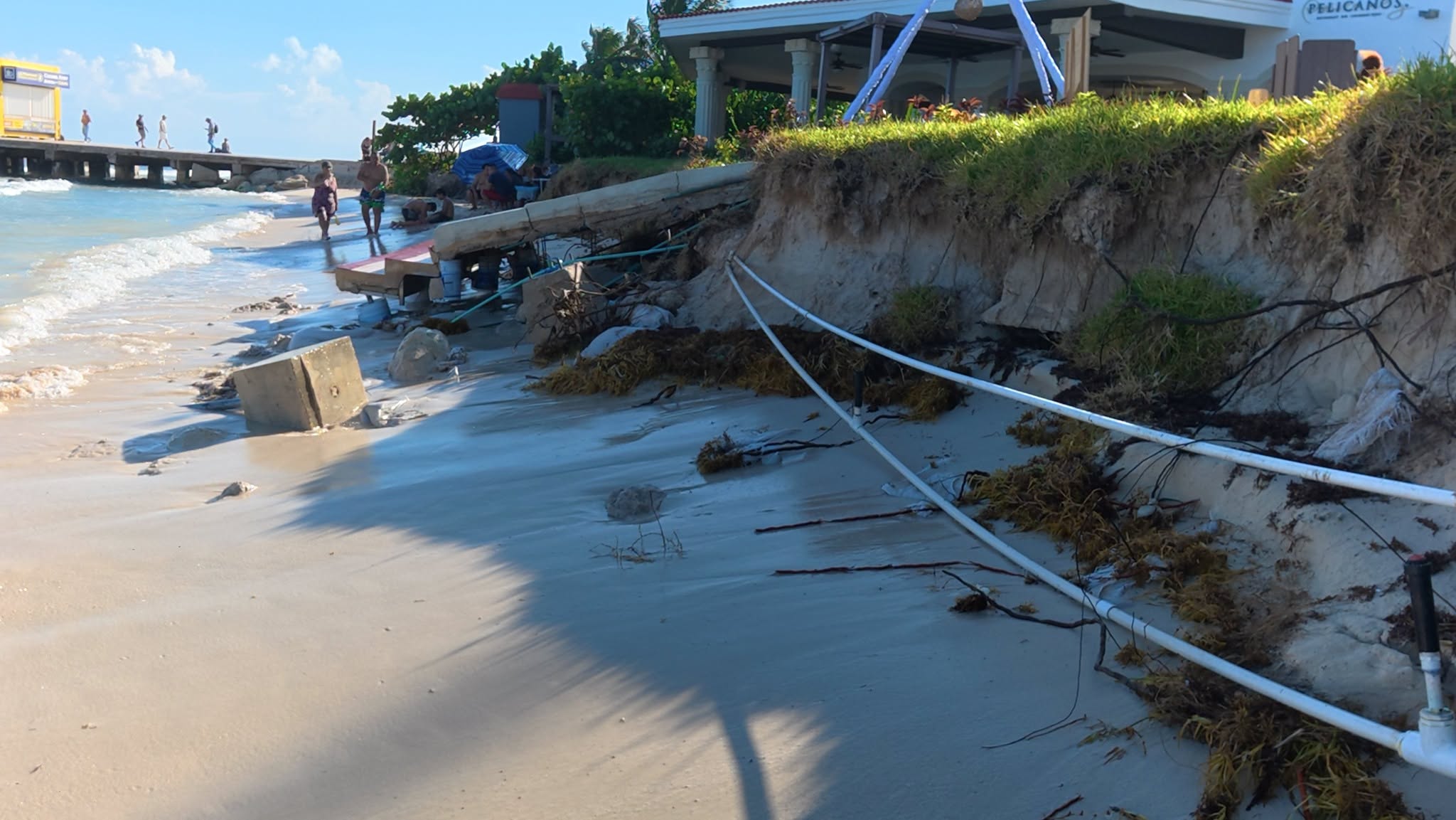
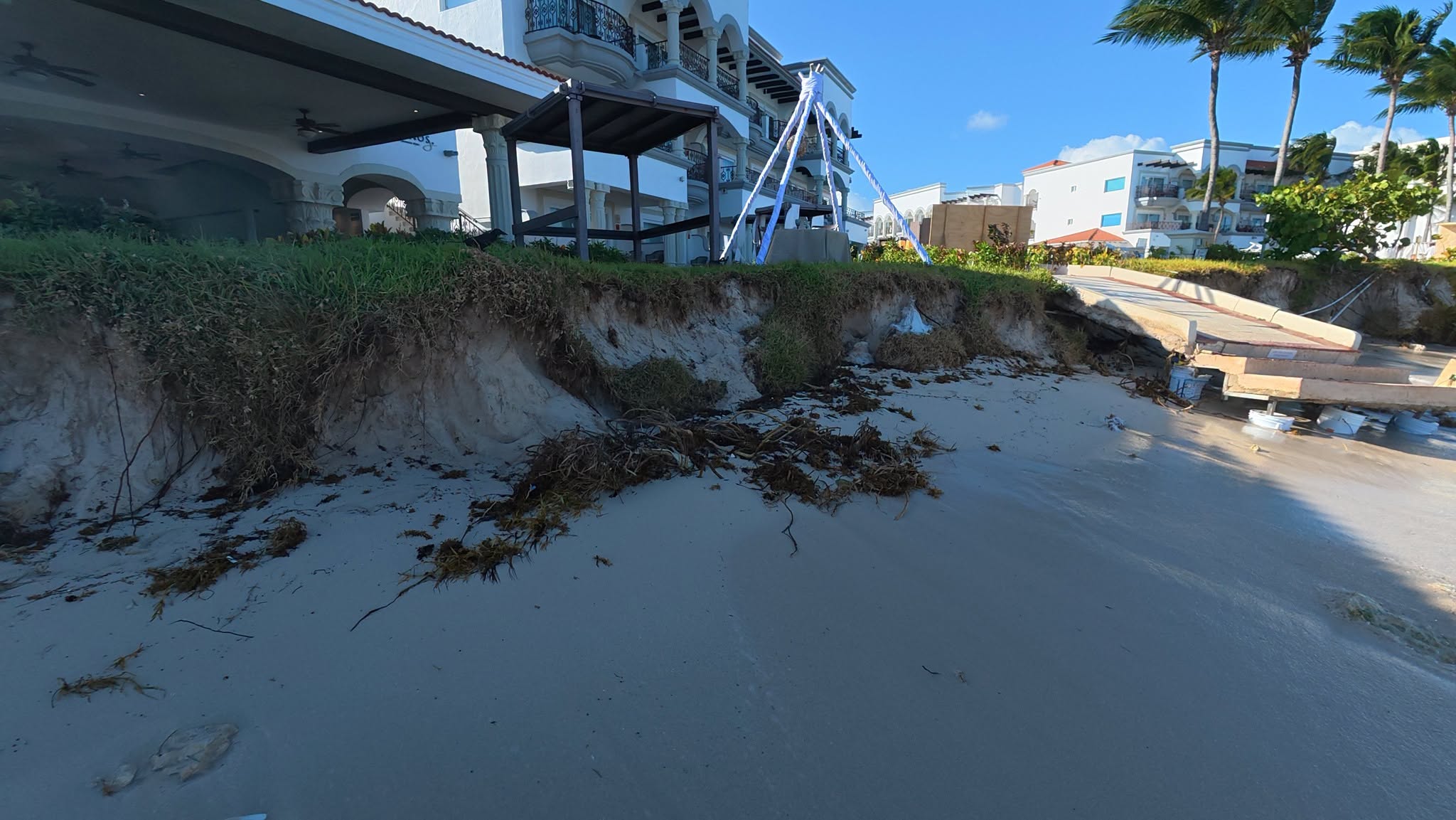
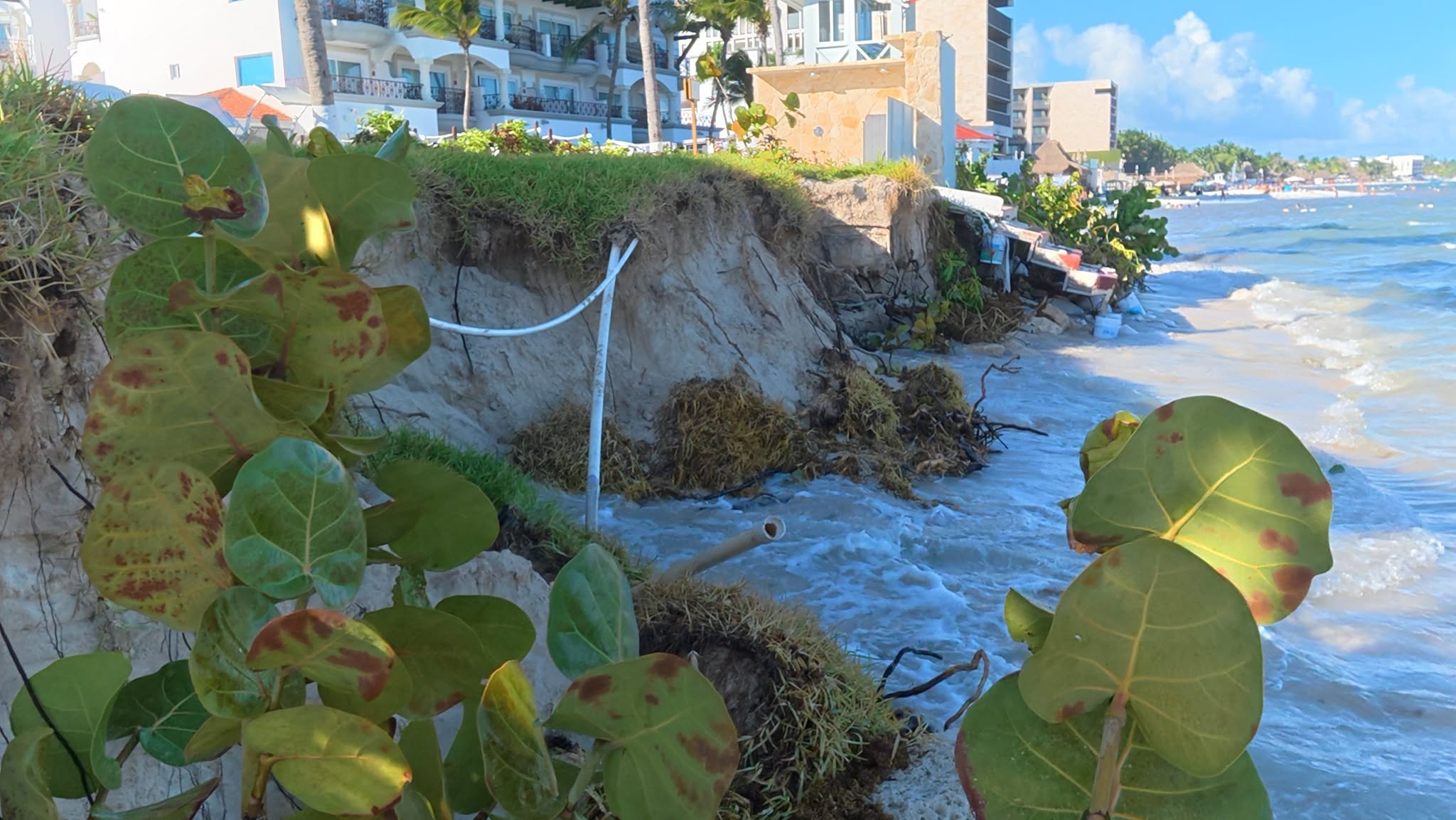
The centre of Playa del Carmen is the part of the town beach most affected by erosion. In April 2026, local environmental groups described five to six kilometres of the town's beaches as severely affected. The photographs in this article were taken by Sargazo Watch at Playa Constituyentes, one of the main public accesses in the centre. They show a steep bank cut into the sand below the hotel gardens, a concrete access stairway that has collapsed onto the beach, irrigation pipes left exposed, and waves reaching the foot of the bank.
On this coast, sand that leaves one beach often builds up on another further along the shore. In 2024, the municipal maritime zone office (Zofemat) explained that the movement of sediment had stripped sand from Playa Mamitas while Punta Esmeralda and the beach at Calle 38 gained width. In July 2026, the beach at Calle 38 was again reported to have recovered most of its sand after several months of erosion. The same stretch of coast can therefore look very different from one season to the next.
The municipality began a diagnostic study of the town's beaches in 2025, starting in the centre between the Juárez and Constituyentes piers and then extending north to Xcalacoco. In September 2026, the director of Zofemat, Irving Lili Madrigal, reported that the municipality had applied to Semarnat for permission to return to the beach part of the sand removed together with sargassum during the clean-ups of the previous two years. The points identified for that sand include El Recodo, Calle 10, Calle 12 and the area of the Xaman-Ha pier in Playacar. The permit had not been granted at the time of that report.
Private coastal projects near Playa del Carmen
Alongside the public programmes, individual landowners and hotels have applied to Semarnat for their own coastal works, with mixed results.
In September 2026, Semarnat authorised, subject to 19 conditions, the project known as Restitución de la Playa Bahía del Carmen, on the coast between the Tres Ríos and Blue Bay Grand Esmeralda resorts, north of the city. According to its environmental impact statement, the shoreline there has retreated by more than 30 metres since 2004. The project combines three breakwaters parallel to the shore with an artificial sand fill and a new dune, using sand from an offshore bank in front of Playa Mamitas, about 9.5 kilometres away.
In the same month, according to a regional news outlet, Semarnat refused authorisation for a coastal protection project at the Secrets Moxché hotel, north of Playa del Carmen, after finding that part of the works had already been carried out without federal approval.
Cancún: the works at Playa Delfines and the coastal study
Heavy machinery and excavations at Playa Delfines, also known as El Mirador, drew public attention in October 2026. These works were not a beach widening or sand recovery project. They concerned the Tikal AMX-3 submarine fibre-optic cable, promoted by Telxius México and authorised by Semarnat, which comes ashore at a landing point beside Playa Delfines. According to the project supervisor, the works consisted of uncovering the cable, reinforcing its protective casing and burying it deeper in the rock. According to Conanp, the federal protected areas agency, the works lay in the federal beach strip, outside the protected natural area.
Because Playa Delfines is a sea turtle nesting beach, an environmental group, the Grupo Ecologista del Mayab, announced a complaint to Profepa, the federal environmental enforcement agency, asking it to review the permits and any damage to the dune.
For the wider Cancún coastline, a separate study of 26 million pesos was announced in August 2026 to assess the Cancún hotel zone section by section and define which measures each part requires, including the restoration of dunes, seagrass and mangroves, before any new sand is placed. Municipal officials indicated in June 2026 that the resulting works may not begin before 2027.
Puerto Morelos
Puerto Morelos joined the state programme through an extension of the earlier authorisation, requested by the state in 2025 and approved by Semarnat in August 2026. According to reports, the approval carries specific conditions because this stretch of coast lies close to the Mesoamerican Reef and the Puerto Morelos Reef National Park.
The municipality is also preparing its own plan. In September 2026, the technical committee of the Puerto Morelos environmental sanitation fund approved funding for the first stage of an executive project for beach recovery, together with the anchoring of sargassum barriers offshore.
Cozumel
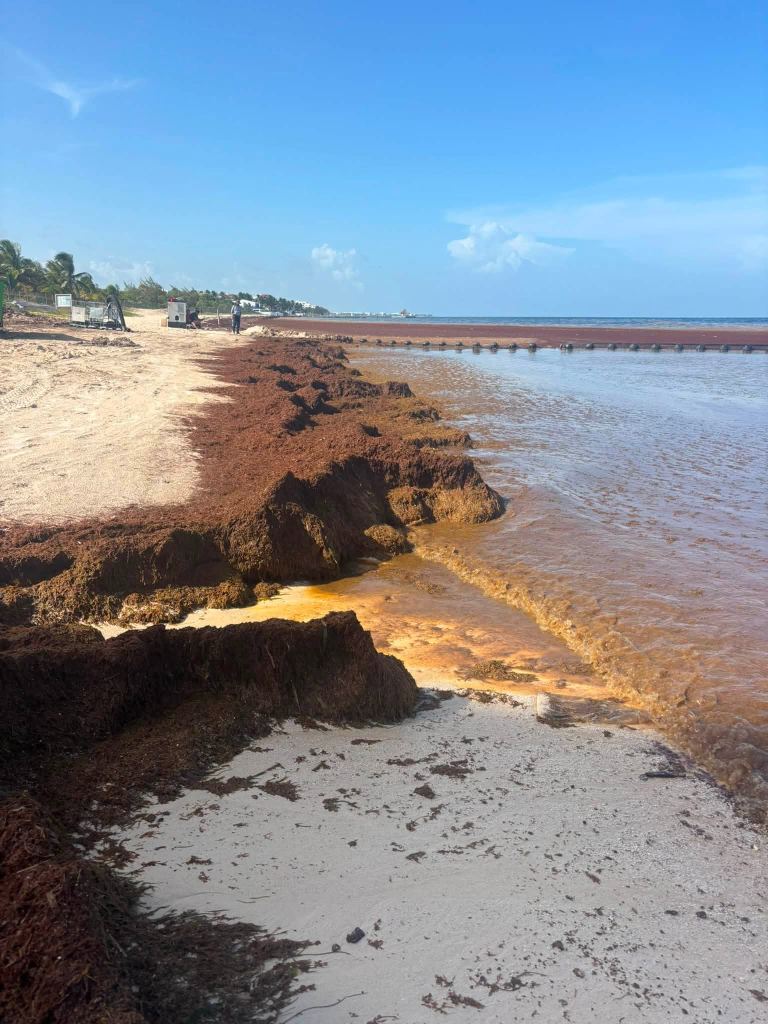
Cozumel has the smallest section of the state programme, about 1.5 kilometres. It is covered by the same Semarnat authorisation of August 2026 and the same pending conditions as the other three municipalities. The published reports do not specify which of the island's beaches the section includes.
New breakwaters in Akumal
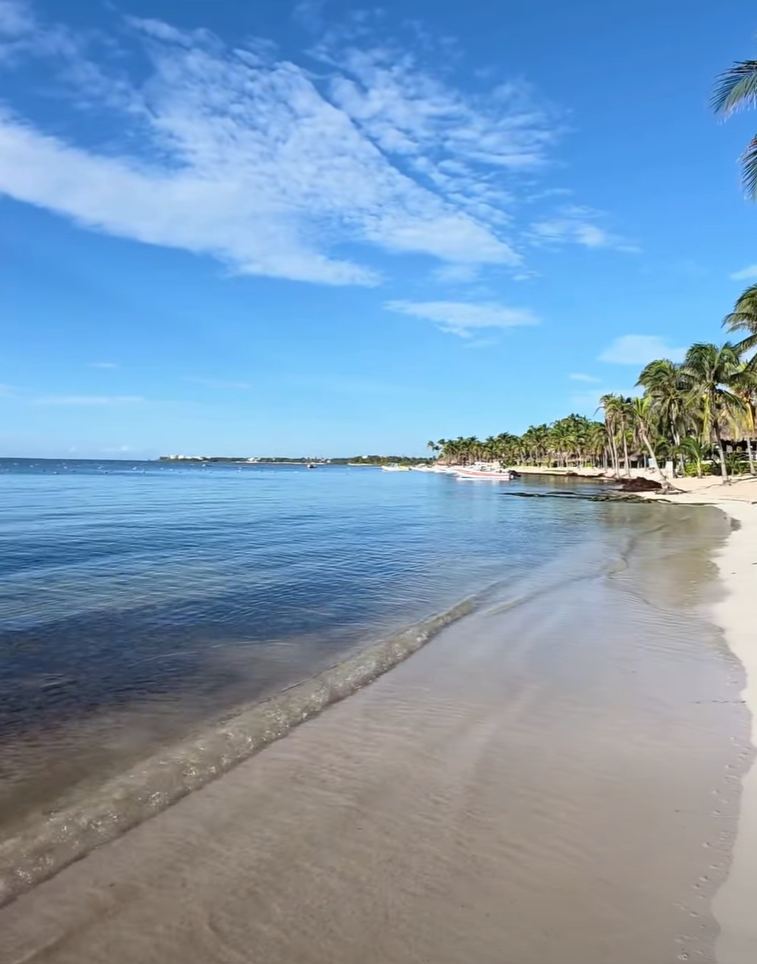
In October 2026, Semarnat authorised a beach stabilisation project in front of the Secrets Akumal resort, in the municipality of Tulum. The project consists of two concrete breakwaters, 35 and 45 metres long, to be placed about 25 metres from the shore in roughly one metre of water, with an investment of 27 million pesos that includes environmental monitoring. Unlike many earlier projects, it does not involve placing sand on the beach: the structures are intended to reduce wave energy and allow sand to build up naturally. The authorisation allows the works to be carried out over a period of three years, because they must pause during the sea turtle nesting season.
The situation in Tulum
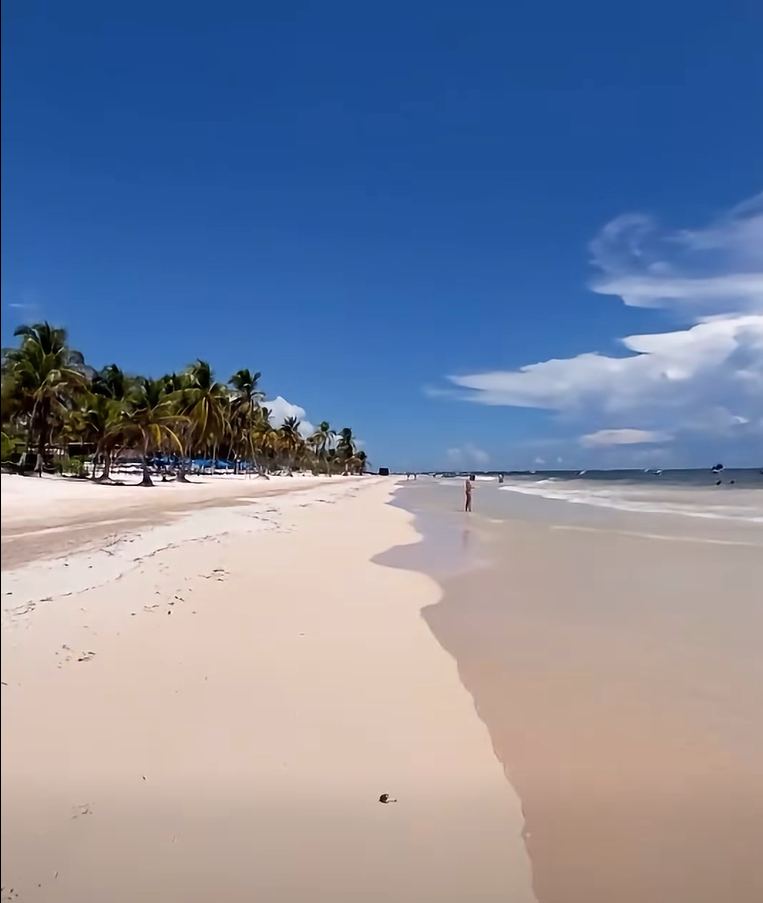
No beach restoration programme has been announced for the Tulum hotel zone. In August and September 2026, the head of Zofemat in Tulum, David Buchanan, stated that the clean-up of sargassum had not caused a significant loss of sand there, and that the beaches of the hotel zone and of the Tulum National Park remain wide. He attributed this to the effort by Zofemat, the Navy and Conanp to limit the use of heavy machinery and to avoid removing sand together with the sargassum.
Sargassum clean-up and the loss of sand
The contrast between Tulum and central Playa del Carmen points to one factor that the authorities can control. In June 2026, residents and specialists in Playa del Carmen raised concerns that heavy machinery operating directly on the sand to remove large accumulations of sargassum was also removing significant volumes of sand, accelerating erosion. The municipal plan to return sand separated from collected sargassum is a direct response to that problem.
Erosion and sargassum are nonetheless separate processes. Storms, high tides and winter cold fronts move sand along the coast regardless of sargassum, and structures built on or near the dunes limit the beach's ability to recover. Most of the projects described here will take months or years to reach the beach itself.
Implications for visitors
For a visitor, the practical consequence is that beach width now varies considerably within the same town. In Playa del Carmen, the centre between Fundadores and Constituyentes has the narrowest sand, while beaches further north, such as Calle 38, have recently been in better condition. Our ranking of the best beaches in Playa del Carmen and the dated photographs on the live map show the current state of each beach.