Cenote · Tulum
Cenote Dos Ojos: two flooded eyes of the world's largest cave system
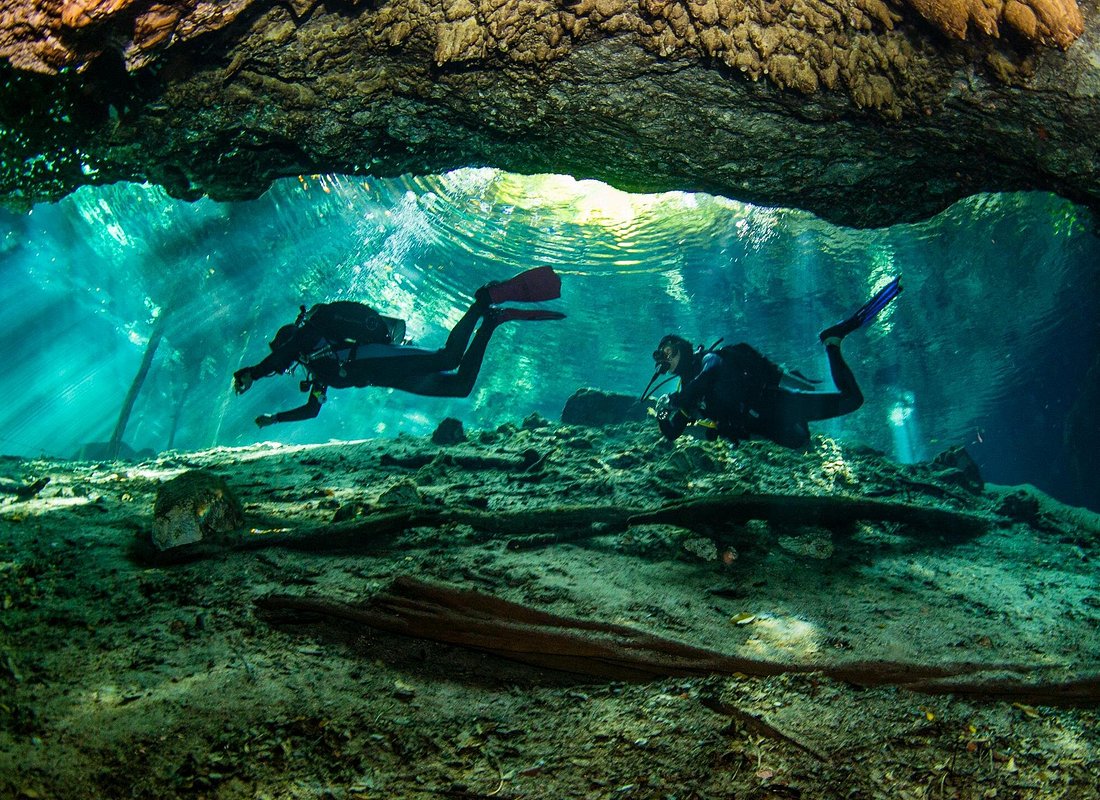


Two cenotes joined by a flooded passage, part of Sac Actun, the largest surveyed underwater cave system on earth.
- The activity
- Two large cenotes, the “two eyes,” joined by a flooded passage roughly 400 m long. Both are part of Sac Actun, the largest surveyed underwater cave system in the world at around 347 km mapped.
- Location
- Off Highway 307, about 14 km north of Tulum and roughly 1 km from Xel-Há. The ticket office is on the highway, then about 2 km of dirt road to the cenote itself.
- Duration
- Two to three hours for the two cenotes at a snorkelling pace. Divers allow a half day for a two-cavern dive.
- Best time to arrive
- At opening, around 9am. The caverns are quietest and the water clearest before the tour vans reach the park in mid-morning.
- Admission cost
- Around 400 pesos including a life jacket, or about 800 pesos for the guided snorkel tour, which is what gives access to the Bat Cave. Cash in pesos.
- Facilities
- Changing rooms, showers, toilets, lockers for rent, a restaurant and a picnic area. Among the better-equipped cenotes in the area, which suits families.
- For divers
- Two cavern routes: Barbie, about 515 m with a maximum depth near 6.5 m, no current and accessible to open-water divers, and the Bat Cave, about 312 m, darker and narrower with more sediment.
- Also in the park
- Dos Ojos Park also contains Cenote Jaguar, Nicte-Ha, El Pit and Los Monos. Nicte-Ha in particular is quieter.
What to expect
The first eye is the brighter of the two, a large open pool where daylight reaches the water and the visibility runs to tens of metres. It is where snorkellers spend most of their time, floating above submerged formations with the floor clearly visible well below.
The second eye is darker and more enclosed, connected to the first by a flooded passage roughly 400 metres long. Snorkellers see the entrance to that passage; divers swim it. The change in light between the two is the reason the site is named as it is.
The wider park holds further cenotes and a bat cave on the same admission, reached on foot or by the park shuttle. Facilities are basic but functional, with changing rooms, lockers and life jackets available.
For divers Dos Ojos is one of the best-known cavern dives in the world, part of the Sac Actun system, and certification requirements apply. Snorkellers and divers use the same entrance but follow entirely different routes.
The honest takeaway
Reviewers rate the caverns highly. The points worth knowing in advance are the cost, the access road and how busy the park becomes once the tour vans arrive.
What visitors praise
- Genuine cavern swimming. The passage and the low stalactite ceilings are what visitors describe as unlike any other cenote nearby.
- Two cenotes for one ticket. Both eyes are included, and each has a different character in light and depth.
- Excellent for divers. The Barbie line is accessible to open-water divers, which is unusual for a cavern site of this reputation.
- Proper facilities. Showers, lockers and a restaurant make a longer visit comfortable rather than an endurance test.
What visitors find difficult
- Expensive for a cenote. Around 400 pesos, and double that for the guided tour, against 150 to 350 at many nearby sites.
- The access road is rough. Roughly 2 km of dirt track after the highway ticket office surprises visitors in low hire cars.
- Very busy from mid-morning. Tour groups arrive in volume and the platforms and staircases become congested.
- The Bat Cave is not in the basic ticket. Visitors who arrive expecting the full cave system on standard entry are routinely disappointed.
Drawn from the recurring themes in public visitor reviews of the activity and the tours that reach it. We do not reproduce individual reviews or aggregate scores; for current ratings, check Viator or another booking platform directly.
Getting there
The ticket office sits directly on Highway 307 about 14 km north of Tulum, close to Xel-Há and easy to spot. From there it is roughly 2 km of unpaved road to the cenote entrance, passable in a normal car but slow. Colectivos on the Tulum to Playa del Carmen route will drop you at the highway office, leaving the dirt road on foot or by taxi, so a car or an organised tour is the more practical option.
Because it pairs naturally with Akumal a few minutes north, many half-day tours combine turtles in the morning with Dos Ojos afterwards.
How to make the most of the day
- 1Arrive at opening. The cavern is quiet, the water undisturbed and the light through the openings at its best before the vans arrive.
- 2Pay for the guided snorkel if the caves are why you came. The Bat Cave is the difference between a swim and a cave experience, and it is not in basic entry.
- 3Bring cash in pesos. Entry and locker hire are cash-only, and the ticket office is not somewhere to discover that.
- 4Apply no sunscreen beforehand. Chemical sun cream is not permitted in the water and you will be asked to rinse.
- 5Consider Nicte-Ha in the same park. It is quieter and more natural, and visitors often rate it above Dos Ojos itself on a busy day.
- 6Pair it with Akumal, not another cavern. Turtles in the morning and Dos Ojos afterwards is the strongest half-day on this stretch of coast.
Sac Actun, and what lies below
Dos Ojos is a window into Sac Actun, the largest surveyed underwater cave system in the world, with roughly 347 km of mapped passage. Divers connected it to the neighbouring Dos Ojos system in 2018, which merged the two into a single network. What you swim in is a small, lit fragment of something that continues in darkness for hundreds of kilometres.
The formations tell you the caves were once dry. Stalactites and stalagmites only grow in air, so every formation now underwater formed during the last ice age, when sea level sat far lower and these passages were open caverns. As the ice melted the water table rose and drowned them, preserving the formations and, in places, the bones of animals and early humans who used the caves when they were dry.
That is also why the water is so clear. There is no surface river carrying silt; the water has filtered slowly through limestone, arriving almost free of sediment. Disturbing the fine silt on the floor is the one thing that ruins visibility, which is why divers here are taught buoyancy control before anything else.
Some links to tours and activities are affiliate links. If you book through them, Sargazo Watch may earn a small commission at no extra cost to you.