What's driving the sargassum boom? Understanding the Great Atlantic Sargassum Belt
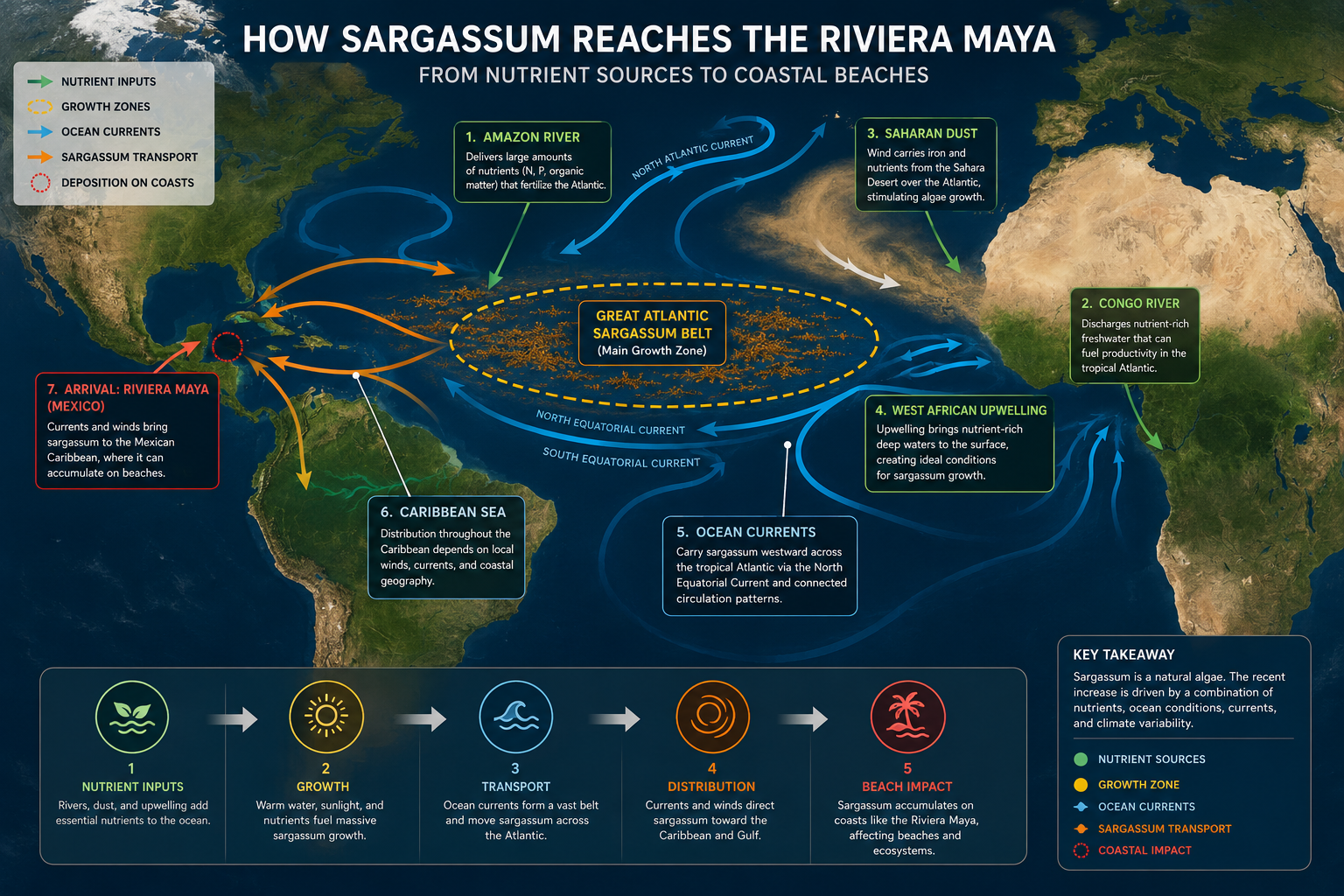
How sargassum reaches the Riviera Maya — from nutrient sources to coastal beaches.
- Short answer
- The surge is driven by a combination of increased nutrients, changing ocean conditions, currents, and climate-related factors.
- The key change
- Around 2011, researchers began observing a vast new system: the Great Atlantic Sargassum Belt.
- Main nutrient sources
- The Amazon River, Congo River, ocean upwelling, and Saharan dust.
- Why it matters
- More growth offshore increases the likelihood of large beach landings across Mexico and the Caribbean.
If sargassum is natural, why is there suddenly so much more of it?
As we explained in our article What is sargassum (sargazo)?, sargassum is a naturally occurring floating algae that has existed in the Atlantic Ocean for centuries. So why has it become such a major issue only in recent years?
The answer appears to be a combination of factors that together create ideal conditions for rapid growth. Scientists do not believe there is a single cause. Instead, evidence suggests that nutrient inputs, ocean circulation, climate variability, and warmer waters are working together to fuel larger and more persistent blooms.
First: how sargassum naturally grows
Like land plants, sargassum grows through photosynthesis. To thrive, it requires:
- Sunlight
- Warm water
- Nutrients such as nitrogen and phosphorus
- Stable ocean conditions
When these ingredients are available, sargassum can reproduce rapidly and form extensive floating mats. Historically, growth occurred primarily within the Sargasso Sea in the North Atlantic. Today, however, large blooms are occurring across much of the tropical Atlantic Ocean.
The birth of the Great Atlantic Sargassum Belt
One of the most important discoveries in recent years was the identification of the Great Atlantic Sargassum Belt (GASB). This enormous belt of floating algae stretches across the tropical Atlantic from West Africa to the Caribbean and Gulf of Mexico. In some years, it extends for more than 8,000 kilometers (5,000 miles).
Researchers first recognized this new recurring phenomenon after the unprecedented bloom events that began around 2011. Since then, seasonal outbreaks have become increasingly common.
The existence of this vast reservoir means that large amounts of sargassum are now available to be transported toward Caribbean coastlines every year.
The Amazon River: a giant source of nutrients
One of the leading scientific explanations involves nutrient-rich freshwater flowing from the Amazon River into the Atlantic Ocean. The Amazon is the largest river on Earth by discharge volume. Each year it delivers enormous quantities of:
- Nitrogen
- Phosphorus
- Organic matter
- Sediments
These nutrients can act as fertilizer for marine algae. Researchers believe that increasing agricultural activity, fertilizer use, and land-use changes throughout parts of the Amazon basin may be contributing additional nutrients to coastal waters. More nutrients can support faster sargassum growth once the algae reaches favorable conditions.
The Congo River may also play a role
The Congo River, Africa's largest river system, is another major source of nutrients entering the tropical Atlantic. Although it receives less public attention than the Amazon, scientists believe it may also contribute nutrients that support sargassum growth.
Because the Great Atlantic Sargassum Belt stretches between Africa and the Americas, nutrient inputs from both continents may influence bloom development. Research into the Congo's role is ongoing, but it is increasingly recognized as an important piece of the puzzle.
Saharan dust: fertilizer falling from the sky
Every year, hundreds of millions of tons of dust are carried westward from the Sahara Desert. This dust contains minerals and nutrients, including:
- Iron
- Phosphorus
- Trace elements
When deposited into the Atlantic Ocean, these nutrients can stimulate biological productivity. Scientists have long known that Saharan dust helps fertilize parts of the ocean and even the Amazon rainforest. Many researchers believe it may also contribute to the growth of large sargassum blooms under the right conditions.
Ocean upwelling and West Africa
Along portions of the West African coastline, powerful ocean currents bring deep, nutrient-rich water toward the surface. This process is called upwelling. Upwelling naturally increases concentrations of nutrients available for marine life.
When combined with warm temperatures and sufficient sunlight, these nutrient-rich waters can create favorable conditions for sargassum growth. Researchers continue to study how much of the Great Atlantic Sargassum Belt originates from these regions.
Ocean currents: nature's conveyor belt
Growing sargassum is only part of the story. The other part is transportation. Ocean currents act like giant conveyor belts that move floating algae across entire ocean basins. The main flow generally follows this pattern:
West Africa → Tropical Atlantic → Lesser Antilles → Caribbean Sea → Gulf of Mexico → Mexican Caribbean
Once these mats enter the Caribbean, local winds and currents determine which coastlines receive the greatest impacts. This explains why Mexico, the Dominican Republic, Jamaica, Barbados, Puerto Rico, and other Caribbean destinations can all experience major sargassum events during the same season.
Are warmer oceans making the problem worse?
Many scientists believe warming ocean temperatures may be contributing to stronger blooms. Warmer water can:
- Extend growing seasons
- Accelerate biological activity
- Create conditions favorable for algae growth
However, temperature alone cannot explain the phenomenon. Some years with warm ocean conditions produce relatively moderate sargassum seasons, while other years generate record-breaking accumulations. For this reason, most researchers view warming oceans as one contributing factor among several rather than the sole cause.
Climate patterns can influence year-to-year variability
Large-scale climate patterns also affect ocean conditions. Examples include El Niño, La Niña, Atlantic climate oscillations, and variations in rainfall and river discharge. These patterns can influence:
- Nutrient delivery
- Ocean temperatures
- Wind patterns
- Current strength
As a result, no two sargassum seasons are exactly alike. Some years produce relatively light impacts, while others generate extraordinary blooms. This variability is one reason seasonal forecasting remains challenging.
What do scientists agree on?
While research continues, there are several points that most scientists broadly agree on — and several that are still being actively studied.
- Sargassum is a natural species.
- The Great Atlantic Sargassum Belt emerged as a major phenomenon around 2011.
- Nutrient availability is a key driver of growth.
- Ocean currents transport sargassum across the Atlantic.
- The Caribbean is now regularly exposed to large influxes.
- The precise contribution of agricultural runoff.
- The exact role of climate change.
- The relative importance of the Amazon versus the Congo.
- How future ocean conditions may affect bloom size.
In other words, scientists understand many of the mechanisms involved, but the complete picture is still evolving.
What does this mean for the future?
Current research suggests that large Atlantic sargassum blooms are likely to remain a recurring feature of the Caribbean environment. That does not mean every year will be equally severe — some seasons will be lighter, while others may produce substantial beach impacts.
Because of this variability, monitoring has become increasingly important for travelers, coastal communities, tourism operators, researchers, and environmental managers. Understanding where sargassum is today can often be more useful than trying to predict conditions months in advance.
Why monitoring matters
Scientists can monitor the movement of sargassum across entire ocean basins using satellite imagery and oceanographic models. Organizations such as NOAA and the University of South Florida provide valuable regional-scale monitoring and research.
However, travelers usually have a much more practical question: "What are conditions like on my beach right now?" That is where local monitoring becomes essential.
By combining satellite observations, forecasts, local reports, and real-world beach conditions, Sargazo Watch helps bridge the gap between large-scale science and on-the-ground reality. See the live forecast or check your beach on the live map.
The bottom line
There is no single explanation for the rise of sargassum. Instead, scientists believe that multiple factors — including nutrient-rich river discharge, Saharan dust, ocean currents, favorable temperatures, and climate variability — have combined to create the Great Atlantic Sargassum Belt.
The result is a new reality in which large quantities of sargassum regularly move across the Atlantic and reach Caribbean coastlines. Although researchers continue to study the phenomenon, one thing is clear: sargassum is no longer just a localized issue — it has become one of the most important environmental challenges facing Caribbean beaches today.
Sources
- Wang, M., Hu, C., et al. (2019). "The great Atlantic Sargassum belt." Science.
- NOAA AOML — Sargassum Research and Monitoring.
- University of South Florida, Optical Oceanography Lab — Sargassum Watch System (SaWS).
- NOAA CoastWatch — Sargassum FAQ.