- What is it?
- Floating brown seaweed (algae) that drifts on the ocean surface.
- Season
- Typically peaks spring–summer in the Caribbean and Gulf of Mexico, though it varies year-round.
- Where
- Atlantic Ocean, Caribbean Sea, Gulf of Mexico, and beaches across the Caribbean region.
- Key statistic
- Quintana Roo collected ~91,500 tons in 2025 — a 147.3% increase over 2024.
What is sargassum?
Sargassum is a type of floating brown algae, commonly called seaweed. Unlike most seaweeds, it does not attach itself to the seafloor. Instead, it spends its entire life floating at the ocean surface, where it can form large mats stretching for kilometers.
The term "sargassum" is the scientific name used internationally. It originates from the Portuguese word "sargaço," which was historically used to describe floating marine vegetation. The famous Sargasso Sea in the North Atlantic was named after these floating algae.
In Spanish-speaking countries, especially Mexico and the Caribbean, the same phenomenon is commonly called "sargazo."
- Sargassum — scientific and international term
- Sargazo — Spanish term commonly used in Mexico and the Caribbean
Both words refer to the same floating algae.
A natural part of the ocean
Many people assume sargassum is pollution. It is not. Sargassum is a natural component of the Atlantic Ocean ecosystem and has existed for centuries.
In the open ocean, it provides important benefits:
- Habitat for fish, crabs, shrimp, and other marine species
- Nursery grounds for juvenile fish
- Shelter for sea turtles during early life stages
- Food source for numerous organisms
- Temporary storage of carbon through photosynthesis
Scientists sometimes refer to it as a "golden floating forest" because entire marine ecosystems develop around it. When present in moderate amounts offshore, sargassum plays a valuable ecological role.
The two faces of sargassum
Sargassum is neither inherently good nor bad. In the open ocean, it acts as a floating ecosystem that supports marine biodiversity. Many fish species, invertebrates, and young sea turtles depend on it for food and protection.
Problems arise when unusually large quantities accumulate near coastlines. What was once a beneficial offshore habitat can become an environmental challenge when thousands of tons wash ashore and begin decomposing.
The issue facing the Caribbean today is not the existence of sargassum itself, but the unprecedented volumes that have appeared since the early 2010s.
What happens when sargassum reaches the beach?
Freshly arrived sargassum is generally less problematic. The problems begin when large accumulations remain on shore and start decomposing.
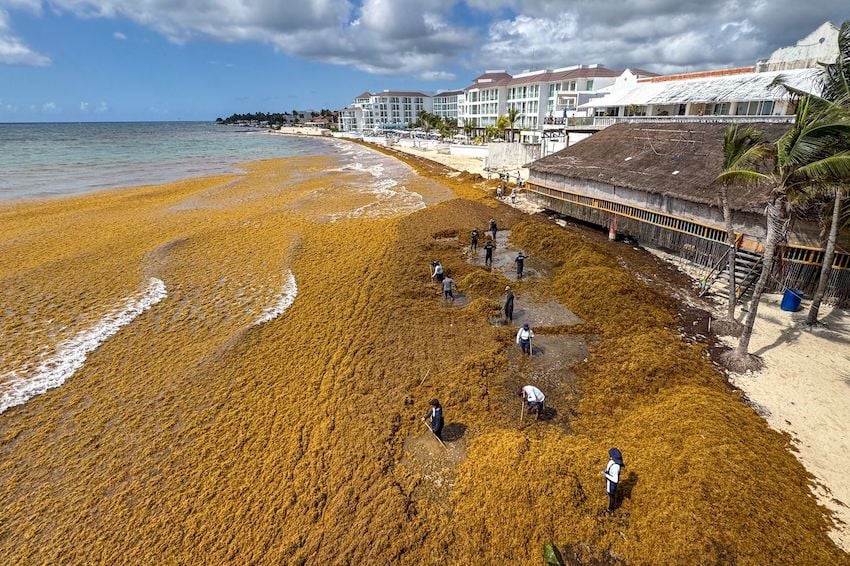
As the algae breaks down:
- It releases hydrogen sulfide (H₂S)
- It emits ammonia and other gases
- It produces the characteristic "rotten egg" odor
Decomposing piles can:
- Reduce beach enjoyment
- Affect tourism
- Create unpleasant odors near hotels and homes
- Reduce oxygen levels in shallow coastal waters
- Smother seagrass beds and coral ecosystems
This is why beach management teams often try to remove heavy accumulations before decomposition accelerates.
How excess sargassum affects marine life
While moderate amounts of offshore sargassum provide important ecological benefits, excessive accumulations can negatively affect coastal ecosystems.
1 Oxygen depletion
One of the most significant risks occurs during decomposition. As large quantities of sargassum break down, bacteria consume dissolved oxygen in the surrounding water. This can create hypoxic (low-oxygen) conditions, stressing or killing marine organisms that cannot escape.
Species potentially affected include fish, crabs, mollusks, sea cucumbers, and other bottom-dwelling organisms. In severe cases, localized fish kills have been reported in affected coastal areas.
2 Seagrass and coral shading
Dense floating mats can block sunlight from reaching seagrass beds, coral reefs, and bottom-dwelling algae. Reduced light means reduced photosynthesis. Over time, this can weaken seagrass ecosystems and place additional stress on coral reefs that are already facing pressures from warming oceans and pollution.
3 Sea turtle nesting problems
Sea turtles naturally interact with offshore sargassum throughout their life cycle. Young hatchlings often use floating sargassum mats as shelter from predators during their first years at sea.
However, massive beach accumulations can create challenges by obstructing nesting females, altering nesting habitat, and trapping hatchlings attempting to reach the ocean. Species potentially affected include the green sea turtle, loggerhead sea turtle, and hawksbill sea turtle.
4 Changes in coastal food webs
Large decomposing accumulations can alter local nutrient cycles. As decomposition progresses, nutrient concentrations change, microbial communities shift, and water quality may deteriorate. These changes can favor some organisms while harming others, disrupting the ecological balance of lagoons, mangroves, and shallow coastal waters.
5 Release of hydrogen sulfide
Decomposing sargassum produces hydrogen sulfide (H₂S) and ammonia. Hydrogen sulfide is responsible for the familiar "rotten egg" smell associated with large beach accumulations. At elevated concentrations, it can stress marine organisms and contribute to degraded environmental conditions in enclosed coastal systems.
Why can two nearby beaches have completely different conditions?
One of the most common questions travelers ask is: "Why is one beach covered in sargassum while another nearby beach is clean?" Several factors influence beach conditions.
- Ocean currents — even small changes in local currents can redirect large floating mats toward one shoreline and away from another.
- Wind direction — onshore winds can push sargassum toward beaches, while offshore winds may keep it away.
- Coastal geography — protected bays, coves, and headlands often accumulate more sargassum than exposed coastlines.
- Cleanup operations — some destinations invest heavily in offshore barriers and daily removal; others have limited resources.
Because of these factors, beach conditions can vary dramatically even within the same destination on the same day.
This is why real-time monitoring beats broad regional forecasts. Our live beach map tracks conditions beach by beach, while the Forecast page shows NOAA's daily satellite view of the belt heading our way.
Historical trends: why is everyone talking about sargassum now?
For centuries, sargassum was primarily associated with the Sargasso Sea. That changed around 2011, when scientists began observing unprecedented accumulations across the tropical Atlantic, Caribbean Sea, and Gulf of Mexico.
Researchers now describe a massive recurring system known as the Great Atlantic Sargassum Belt, which can stretch thousands of kilometers across the Atlantic Ocean. Since then, several years have produced record-breaking quantities. One example comes from Quintana Roo, Mexico.
The dramatic increase highlights why monitoring and forecasting have become increasingly important for coastal communities and travelers alike.
Who monitors sargassum?
Tracking sargassum requires a combination of satellite imagery, oceanographic models, scientific research, and local observations.
NOAA AOML & CoastWatch
The National Oceanic and Atmospheric Administration (NOAA), through its Atlantic Oceanographic and Meteorological Laboratory (AOML) and CoastWatch programs, monitors sargassum using satellite imagery and ocean observations.[1][2] Their products help identify large-scale movements across the Atlantic and estimate the likelihood of coastal impacts.
University of South Florida
The University of South Florida is one of the world's leading research institutions studying sargassum. Its satellite-based monitoring program has become a major scientific reference for understanding seasonal abundance and tracking the Great Atlantic Sargassum Belt.[3]
Sargazo Watch
Satellite imagery is extremely valuable for monitoring ocean-wide conditions, but travelers often want to know something much more specific: "What does my beach look like today?"
Sargazo Watch bridges that gap by combining scientific monitoring with local observations, beach reports, photographs, forecasts, and real-time conditions. Together, these systems provide a complete monitoring chain:
Ocean-wide monitoring → Regional forecasting → Local beach conditions
The bottom line
Sargassum is a naturally occurring floating algae that has supported marine ecosystems for centuries. In moderate quantities, it functions as a valuable offshore habitat often described as a "golden floating forest."
The challenge facing the Caribbean today is not the existence of sargassum itself, but the extraordinary quantities that have appeared since 2011. When large accumulations reach shore and begin decomposing, they can affect beaches, tourism, marine ecosystems, water quality, and coastal communities.
Understanding where sargassum comes from, how it moves, and why it is increasing is essential for residents, travelers, researchers, and policymakers alike.
Coming next: In our next article, we answer the question scientists are still actively studying — why is sargassum increasing so much across the Atlantic and Caribbean?
Sources
- NOAA AOML — Sargassum Research and Monitoring.
- NOAA CoastWatch — Sargassum FAQ.
- NOAA AOML / University of South Florida — Sargassum Inundation Reports.
- Quintana Roo 2025 Sargassum Report (91,505.97 tons; +147.31% vs. 2024).