Why the Sargasso Sea is losing its sargassum, and what it means for the Caribbean
The Sargasso Sea, in the subtropical North Atlantic, takes its name from the floating seaweed that has historically concentrated there. A study published in Nature Geoscience in December 2025 found that sargassum in the northern part of the sea has declined by more than 90% since 2015, over the same period in which the Great Atlantic Sargassum Belt, the source of the sargassum reaching Caribbean beaches, has expanded substantially.1
This article summarises that study and its published coverage. Sargazo Watch was not involved in the research; all findings belong to the authors cited below.
Data and methods
The study, led by the University of South Florida's College of Marine Science with Sea Education Association and partner institutions, combined satellite observations from the MODIS instruments on NASA's Aqua and Terra satellites, covering March 2000 to February 2024, with 5,587 surface net samples collected by Sea Education Association research vessels on annual North Atlantic cruises between 1993 and 2023.1
Distribution of sargassum from 2000 to 2023
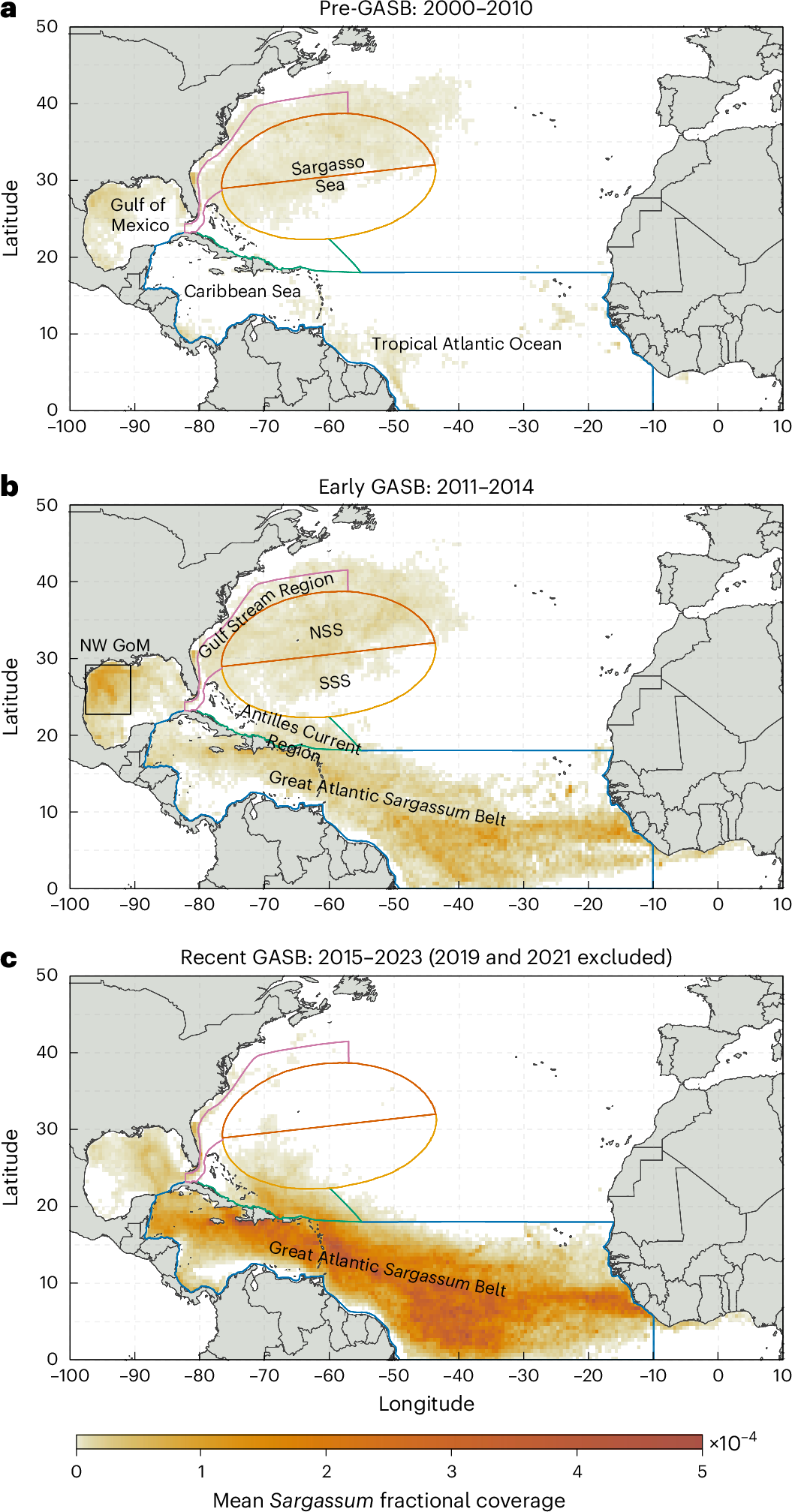
Between 2000 and 2010, most of the Atlantic's floating sargassum was found in the Sargasso Sea, with smaller quantities in the Gulf of Mexico and the Caribbean. In 2011, large amounts appeared in the Caribbean, marking the first appearance of the Great Atlantic Sargassum Belt. The belt has formed every year since, with the exception of 2013, and extends across the tropical Atlantic from West Africa to the Caribbean Sea and the Gulf of Mexico.1
From 2015, sargassum in the northern Sargasso Sea declined sharply. Satellite estimates of mean biomass fell from about 175,000 tonnes between 2000 and 2014 to about 14,000 tonnes between 2015 and 2023, less than a tenth of the earlier level.1,3 Weighted mean densities from the ship samples also fell, from 203 to 113 kg per square kilometre, although the authors note that these cannot be tested statistically in the same way as the satellite record.1
The seasonal cycle has also changed. Sargassum in the northern Sargasso Sea previously peaked in autumn and winter. It now peaks in spring and summer, matching the cycle of the tropical belt, from which most of the remaining sargassum originates.1
Proposed causes
The authors attribute the decline to a reduced supply from the north-western Gulf of Mexico, which they identify as the historical source of sargassum for the northern Sargasso Sea, and present this explanation as a hypothesis. Before 2015, sargassum first appeared in that region around February, was carried by the Loop Current and the Florida Current into the Gulf Stream during spring and summer, and then moved south into the Sargasso Sea in autumn and winter. Between 2015 and 2023, very little sargassum was found in the north-western Gulf.1,2
The study links this reduction to rising water temperatures in the Gulf of Mexico, particularly since 2013, and to marine heatwaves that have become longer, more frequent and more intense since 2015. Sargassum grows best at temperatures between approximately 23 and 28 °C and deteriorates as the water approaches 30 °C. Competition for nutrients with the large quantities of sargassum now arriving from the tropical belt may also contribute.1
Sargassum from the tropical belt has not replaced the historical population. The variety that dominated the belt in its early years, Sargassum natans var. wingei, meets cold, nutrient-poor water of 18 to 22.5 °C when carried north by the Gulf Stream, and none of it survives by October, when the sargassum would normally move south into the Sargasso Sea. The researchers add that sargassum from the belt may already be in poor health by the time it arrives, after a longer journey through warm tropical water.1,2
Implications for the Caribbean
The authors suggest that these changes may mark the beginning of a regime shift in the distribution of Atlantic sargassum. In their assessment, light, temperature and nutrient conditions in the tropical Atlantic are more favourable than those of the Sargasso Sea for maintaining a large population, and the tropical belt has shown no sign of decline since 2011, having instead intensified in recent years.1
The study describes sargassum from the tropical belt arriving in the eastern Caribbean on the North Equatorial Current in early summer, then travelling west and north on the Caribbean and Yucatán Currents towards the Gulf of Mexico between August and December.1 The Yucatán Current runs along the coast of Quintana Roo, which places the Mexican Caribbean on this route. The authors conclude that, if their hypothesis is correct, the shift in the distribution and seasonal timing of sargassum should be expected to continue.1
Offshore quantities alone do not determine which beaches receive sargassum, as local wind and currents decide where it lands. For this reason, Sargazo Watch photographs and scores each beach individually on the live map.
References
- Zhang, Y., Barnes, B. B., Goodwin, D. S., et al. (2025). Dramatic decline of Sargassum in the north Sargasso Sea since 2015. Nature Geoscience, 18(12), 1266 to 1272. Published 4 December 2025. Open access.
- University of South Florida, College of Marine Science (4 December 2025). Study reveals dramatic decline in some historic sargassum populations.
- WUSF (9 December 2025). Warming waters could be contributing to the decline of the Sargasso Sea, its Gulf supply.